Why Businesses Are Investing in AI Faster Than Ever
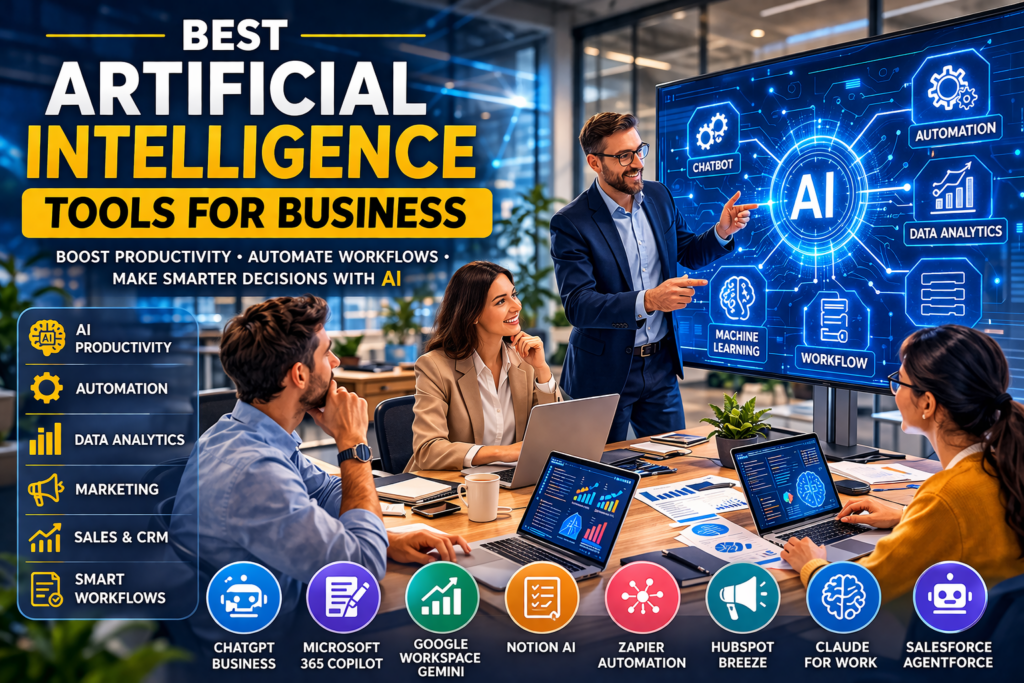
The market for artificial intelligence tools for business is no longer driven by curiosity alone. It is being pushed by real operational pressure. Companies want faster output, leaner teams, better customer experiences, and smarter decisions without hiring endlessly. Stanford’s 2025 AI Index shows that 78% of organizations reported using AI in 2024, up sharply from 55% the year before, while global private investment in generative AI reached $33.9 billion. That combination of adoption and spending tells a clear story: AI has moved from experimental to essential.
That momentum is also visible in executive behavior. McKinsey’s 2025 State of AI found that 71% of organizations regularly used generative AI in at least one business function in 2024, up from 33% in 2023. This is not a tiny efficiency trend hiding in one department. It is a broad shift across marketing, operations, product teams, finance, internal support, and customer communication. The modern company is beginning to treat AI business software like electricity in an office: invisible when it works well, painful when you do not have enough of it.
From an SEO and advertising angle, this topic is especially powerful. Search terms such as best AI tools for business, enterprise AI software, AI productivity tools, AI automation platform, and AI tools for marketing teams attract readers with strong commercial intent. These are often founders, managers, operators, and software buyers already close to a spending decision. That makes the topic attractive not only for organic traffic, but also for premium B2B advertisers that want to appear beside high-value, purchase-ready content. This is exactly the kind of keyword territory where business software brands like to compete.
What Makes an AI Tool Worth Paying For
A flashy demo is not enough. The best AI tools for business earn their place by fitting naturally into real workflows. Before paying for any platform, companies need to judge three things carefully: how secure it is, how well it integrates with existing systems, and how clearly it improves measurable work. If a tool cannot save time, improve quality, or reduce repetitive effort in a visible way, it is not a serious business asset. It is just software theater.
Security is the first filter because business data is never a side issue. Microsoft markets Microsoft 365 Copilot with enterprise AI positioning and emphasizes that it works inside business workflows across Microsoft 365. OpenAI’s ChatGPT Business pricing page places Business and Enterprise plans inside a dedicated business offering. Google’s Workspace materials similarly frame Gemini as part of a managed admin environment inside business productivity tools. Those signals matter because companies are not just buying intelligence. They are buying control, governance, and lower organizational risk.
Integration is the second filter, and it is often the factor that determines adoption. Employees already live in email, documents, meetings, CRMs, project boards, and internal knowledge bases. When AI appears inside those systems, usage becomes easier and more consistent. When AI lives in yet another disconnected app, even a strong model can become background noise. That is why the strongest business AI tools today are not only smart. They are embedded, connected, and designed to work where teams already spend their time.
Best Conversational AI Tools for General Business Use
For many companies, conversational AI is still the easiest entry point. It is flexible, fast to deploy, and useful across many functions. ChatGPT Business stands out because it is positioned specifically for organizational use rather than casual individual usage. OpenAI’s official pricing materials place Business alongside Enterprise as part of its professional lineup, with per-user pricing and team-oriented deployment. That makes it one of the strongest starting points for businesses that want a versatile assistant for writing, planning, summarizing, ideation, and analysis.
The strength of ChatGPT Business is breadth. A marketing team can use it for campaign ideation and content drafts. A sales team can use it to shape outreach messaging and meeting preparation. Operations staff can use it to summarize documents, build internal guides, and structure repetitive tasks. That broad usefulness matters because many companies do not want to buy six AI products before proving value. They want one platform that can create lift across multiple departments from day one.
Claude for Work is another serious option, especially for knowledge-heavy organizations. Anthropic’s official materials position it for professional workflows and provide use cases for integrating Claude across day-to-day work. Anthropic also highlights Claude Cowork as a system for handling multi-step knowledge work on a user’s behalf, especially on desktop workflows involving local files and applications. That makes Claude especially appealing for teams that care about thoughtful drafting, careful synthesis, and long-document tasks where clarity matters as much as speed.
Best AI Productivity Suites for Daily Office Work
The most effective AI products often win by being almost invisible. That is the strength of Microsoft 365 Copilot. Microsoft’s official business page positions it as an AI tool for productivity inside Word, Excel, Outlook, Teams, PowerPoint, and related business workflows. Instead of asking staff to visit a separate AI destination, Microsoft puts assistance directly inside the apps many teams already use every single day. That is a big advantage because adoption tends to increase when the learning curve shrinks.
For businesses built on Microsoft, the value proposition is easy to understand. Copilot can help draft emails, summarize meetings, organize presentations, assist with spreadsheet work, and connect business chat to work data. Microsoft also emphasizes Copilot Studio for building agents that automate and execute business processes. That pushes the platform beyond simple assistance and into workflow execution. It is not just about helping employees think faster. It is also about helping systems move work forward with less friction.
Google Workspace with Gemini follows a similar idea from the Google side of the market. Google’s official admin documentation says Workspace plans include access to the Gemini app, NotebookLM, and Gemini features across Gmail, Docs, Meet, and more. That matters for companies running on Google’s ecosystem because the AI layer is attached directly to existing habits. Employees do not need to reinvent their day. They simply gain AI support where they already write, communicate, and collaborate.
Best AI Tools for Knowledge Management and Documentation
A surprising amount of business waste comes from scattered information. Teams forget where documents live, repeat questions, redo work, and lose context between meetings. That is where Notion AI becomes valuable. Notion’s official product and pricing pages present it as an AI workspace with features such as Notion Agent, AI Meeting Notes, and Enterprise Search, and the company says core AI features are included in Business and Enterprise plans. This positions Notion as something larger than a writing helper. It becomes a structured knowledge environment.
For growing businesses, that is a meaningful advantage. Product teams can centralize specs, decisions, and meeting outcomes. Marketing teams can keep briefs, calendars, drafts, and research connected in one place. Leadership teams can turn messy internal knowledge into something searchable and reusable. Good AI in documentation is not glamorous, but it can remove daily friction like sand from a machine. Once the gears stop grinding, the whole company starts moving more smoothly.
Notion’s direction also matters strategically. It is not just offering text generation. It is combining workspace structure, connected apps, searchable knowledge, and agent-like behavior. That means it competes in the richer category of AI knowledge management software. For businesses drowning in internal complexity, that is often more valuable than another standalone chatbot. The right knowledge tool does not just help one employee write faster. It helps the entire organization remember better.
Best AI Automation Tools for Operations
If conversational AI is the brain, automation is the hands. Zapier deserves attention because it helps businesses connect AI to real actions across thousands of systems. Zapier’s official site says it supports AI workflows and agents across 8,000+ apps and is trusted by 3 million+ businesses. Those are important signals because they show both broad compatibility and large-scale adoption. A business does not just need answers. It needs workflows that actually move.
This is where automation becomes commercially powerful. A company can use AI to summarize a form submission, then send the result to Slack, create a CRM entry, trigger an email sequence, and update a project board automatically. That is a very different level of value from a tool that only writes a paragraph. The more business systems AI can touch safely and predictably, the more it shifts from assistant to operator. In operations, that change can save real headcount hours every week.
Zapier is especially useful for companies that want automation without building everything from scratch. Its value lies in accessibility. Non-developers can orchestrate workflows that would otherwise require custom engineering or expensive implementation work. For small businesses, agencies, and lean operations teams, that makes Zapier one of the best AI automation tools for business because it turns intelligence into action instead of leaving it trapped in a chat window.
Best AI Tools for Marketing and Sales
Revenue teams need more than generic AI. They need AI with context. That is why HubSpot Breeze stands out. HubSpot’s official AI page describes Breeze as a system built to help teams complete tasks, create content, find information, and automate workflows throughout HubSpot. HubSpot also says Breeze Assistant uses CRM data and connects to the business ecosystem to support tasks like meeting prep, content creation, and strategic analysis. That context layer matters because marketing and sales are only powerful when they reflect the actual customer journey.
In practice, this means a team can work with AI that understands contacts, deals, campaigns, and pipeline activity rather than inventing output in isolation. That creates better personalization, stronger sales prep, and more relevant marketing work. For companies already using HubSpot, this kind of built-in AI feels less like a futuristic experiment and more like a practical growth lever. It is especially attractive for businesses that want better output without adding major workflow complexity.
Salesforce Agentforce targets a similar problem from the enterprise side. Salesforce’s official materials describe Agentforce as an open and extensible platform for building digital labor for customers and employees, using existing workflows, data, and integrations. Salesforce also explains that agents need data, reasoning, and actions, and Agentforce is designed to connect to data sources in real time and use workflows or APIs to complete tasks. That makes it a serious platform for organizations that want AI tied directly to large-scale service, sales, and operations processes.
How to Choose the Right AI Tool for Your Business
The smartest businesses do not start by asking which AI brand is most famous. They start by asking where work is slow, repetitive, expensive, or inconsistent. If teams lose hours every week drafting content, summarizing meetings, or handling repetitive documentation, a conversational or productivity AI tool may create fast value. If the bigger problem is broken handoffs between apps, automation may matter more. If internal knowledge is chaotic, a workspace tool can deliver stronger long-term returns.
It also helps to think in layers. One layer is general assistance, where tools like ChatGPT Business and Claude for Work can help across many tasks. Another layer is ecosystem productivity, where Microsoft 365 Copilot or Google Workspace with Gemini fit directly into the office stack. A third layer is operational specialization, where tools like Notion AI, Zapier, HubSpot Breeze, and Salesforce Agentforce solve more specific workflow or revenue problems. Businesses that buy with this layered mindset usually make better decisions.
A small company does not need to adopt everything at once. It is usually smarter to start with one strong use case, measure the gain, and expand from there. The key is not chasing hype. It is choosing the best artificial intelligence tools for business based on real bottlenecks, real teams, and real outcomes. AI creates the most value when it removes friction that employees already feel every day.
Conclusion
The best artificial intelligence tools for business are the ones that turn intelligence into reliable work. Right now, ChatGPT Business and Claude for Work are strong for flexible knowledge tasks. Microsoft 365 Copilot and Google Workspace with Gemini are excellent for companies that want AI built directly into the office environment. Notion AI helps bring order to internal knowledge. Zapier turns AI into automation across apps. HubSpot Breeze and Salesforce Agentforce show how powerful AI becomes when it is attached to customer context and business processes.
The bigger trend is unmistakable. Stanford shows rising organizational adoption, and McKinsey shows that generative AI use has moved deep into real business functions. Companies are not merely testing AI anymore. They are operationalizing it. The winners will be the businesses that choose tools carefully, integrate them intelligently, and measure value honestly rather than falling for surface-level hype.
In the end, business AI software is not about replacing people. It is about removing drag. It is about giving teams a stronger engine, better maps, and fewer roadblocks. When that happens, AI stops looking like a trend and starts behaving like infrastructure. That is when it becomes worth paying for.
FAQs
1. What is the best AI tool for business overall?
There is no universal winner, but ChatGPT Business is one of the strongest all-around options because it supports writing, planning, summarizing, and research across many departments. Businesses already committed to Microsoft or Google may get more value from Microsoft 365 Copilot or Google Workspace with Gemini because of tighter workflow integration.
2. Which AI tool is best for small businesses?
Small businesses often benefit most from tools that are easy to adopt and useful across many tasks. ChatGPT Business, Notion AI, Zapier, and HubSpot Breeze are strong candidates because they combine usability with clear business applications in content, workflow, and customer management.
3. Which AI platform is best for automation?
For broad no-code and low-code automation, Zapier is one of the strongest choices. Its official platform supports AI workflows and agents across 8,000+ apps, which makes it especially useful for teams that want AI to trigger real actions across multiple business systems.
4. Are AI tools for business safe for company data?
They can be, but businesses should review vendor controls, admin settings, and data policies carefully. Official business offerings from OpenAI, Microsoft, and Google are positioned with organizational deployment in mind, but companies still need internal governance, human review, and clear security practices.
5. Which AI tools are best for marketing and sales teams?
For revenue-focused teams, HubSpot Breeze and Salesforce Agentforce are especially strong because they connect AI to CRM data, customer context, and workflow execution. That makes them more useful for real commercial work than generic AI tools that do not understand the sales pipeline.
Read More :